Meet Nicholas Johnson - Princeton's First Black Valedictorian
Kim Anthony • April 28, 2020

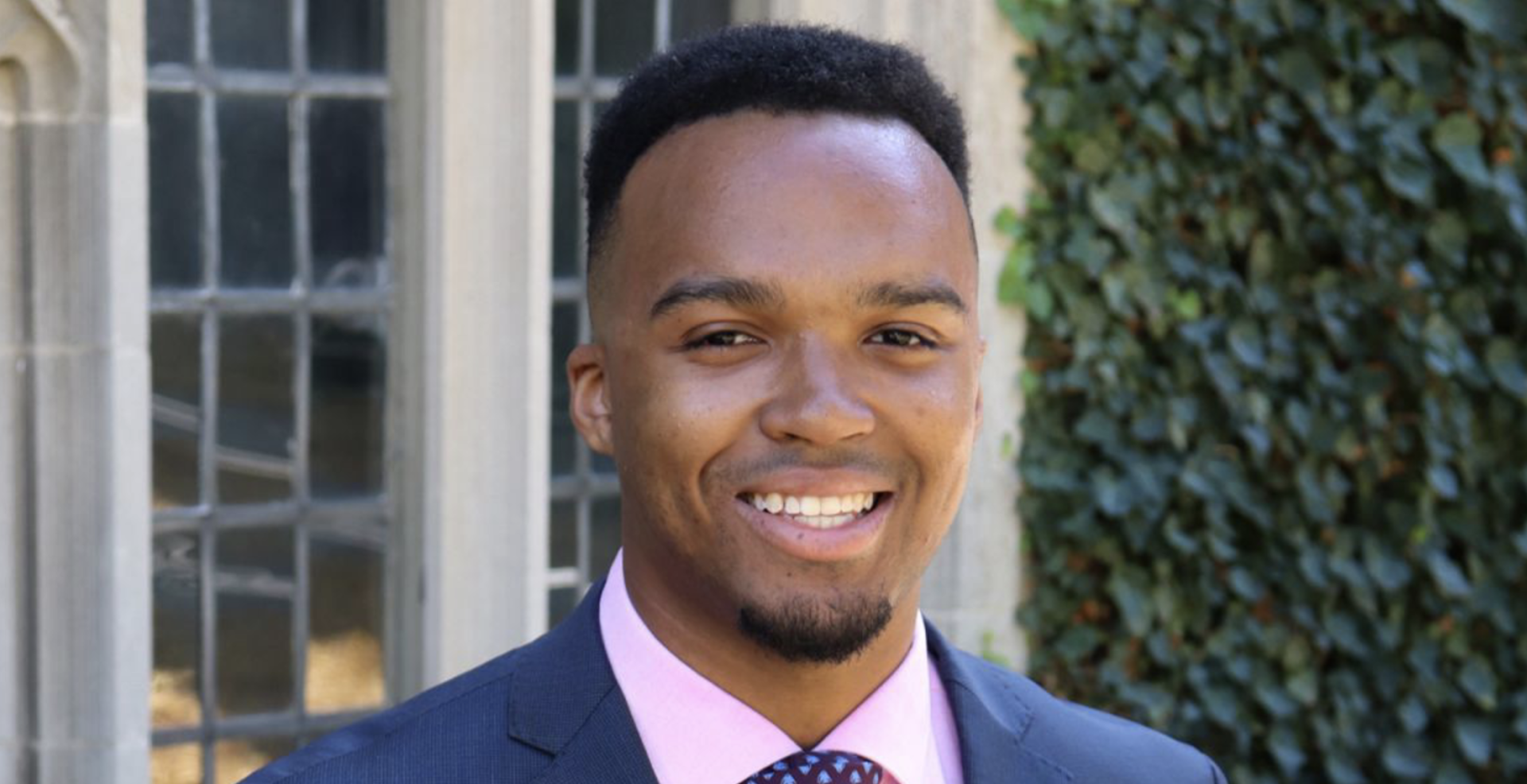
Nicholas Johnson, an operations research and financial engineering concentrator from Montreal, has been named valedictorian of Princeton’s Class of 2020. Grace Sommers, a physics concentrator from Bridgewater, New Jersey, has been named the Latin salutatorian.


Nicholas Johnson


Johnson is the first black valedictorian in Princeton’s history.

He said he appreciates the encouragement he has received at Princeton in developing his academic interests. The University’s support through opportunities including international internships and cultural immersion trips to Peru, Hong Kong and the United Kingdom were especially significant, Johnson said. But most of all, he treasures his relationships with his classmates.

“My favorite memories of my time at Princeton are memories of time spent with close friends and classmates engaging in stimulating discussions — often late at night — about our beliefs, the cultures and environments in which we were raised, the state of the world, and how we plan on contributing positively to it in our own unique way,” Johnson said.

Johnson plans to spend this summer interning as a hybrid quantitative researcher and software developer at the D. E. Shaw Group before beginning Ph.D. studies in operations research at the Massachusetts Institute of Technology in fall 2020.

Along with his concentration in operations research and financial engineering, he is pursuing certificates in statistics and machine learningapplied and computational mathematics, and applications of computing.

His research has focused primarily on sequential decision-making under uncertainty, optimization, and the ethical considerations that must be made given the increasing role of algorithmic decision-making systems.


His senior thesis, “Sequential Stochastic Network Structure Optimization with Applications to Addressing Canada’s Obesity Epidemic,” focuses on developing high-performance, efficient algorithms to solve a network-based optimization problem that models a community-based preventative health intervention designed to curb the prevalence of obesity in Canada.

This work, supervised by Miklos Racz, assistant professor of operations research and financial engineering, also has applications to public health interventions designed to increase adherence to strict social distancing to curb the spread of COVID-19.


Johnson has another ongoing research project supervised by Yacine Ait-Sahalia, the Otto A. Hack ’03 Professor of Finance and professor of economics, in which he is developing a reinforcement learning agent to execute large financial trade orders with minimal market distortion.

During his junior year, Johnson conducted an independent research project, “Generating Privacy Preserving Synthetic Datasets,” supervised by Prateek Mittal, associate professor of electrical engineering, in which he developed a machine learning system to more robustly anonymize datasets than existing alternatives. He presented this work at the spring 2019 Electrical Engineering Symposium and the 2019 Center for Statistics and Machine Learning Symposium.

Among his other professors, William Massey, the Edwin S. Wilsey Professor of Operations Research and Financial Engineering, and Dannelle Gutarra Cordero, a lecturer in African American studies, were also influential.


“Professor Massey inspired me by sharing his ever-present love for operations research and through his advocacy for black and African American students in STEM fields,” Johnson said. “He encouraged me to pursue increasingly ambitious research projects and to share my work at academic conferences. Professor Gutarra introduced me to academic writing during my first-year Writing Seminar. She was instrumental in helping me develop my skills as an effective academic writer and communicator, and she motivated me to become a writing fellow.”


In addition to serving as a writing fellow at Princeton’s Writing Center, Johnson is editor of Tortoise: A Journal of Writing Pedagogy. He is a member of Whitman College, where he has served as a residential college adviser. He is also a member of the Princeton chapter of Engineers Without Borders and served as its co-president in 2018.


As a rising senior, Johnson worked as a software engineer in machine learning at Google’s California headquarters.

He previously interned at Oxford University’s Integrative Computational Biology and Machine Learning Group, developing and implementing a novel optimization technique under the supervision of Aleksandr Sahakyan, principal investigator and group head. He presented the project at Princeton’s inaugural Day of Optimization in October 2018 and at the 25th Conference of African American Researchers in the Mathematical Sciences in June 2019, where his project was recognized with the Angela E. Grant Poster Award for Best Modeling.


Johnson has interned at Montreal Institute for Learning Algorithms, and he participated in Whitman’s exchange program with Morningside College at the Chinese University of Hong Kong in March 2017.


Among his academic honors, Johnson is a recipient of the Class of 1883 English Prize for Freshmen in the School of Engineering, a two-time recipient of the Shapiro Prize for Academic Excellence, and co-recipient with Sommers of the Class of 1939 Princeton Scholar Award. He was elected to Phi Beta Kappa in fall 2019 and to Tau Beta Pi in 2018, where he served as president of the Princeton Chapter in 2019.


Johnson is a graduate of Selwyn House School and attended Marianopolis College, both in Westmount, Quebec.


Never Miss a Story.
SUBSCRIBE

Contact Us

By Kim Anthony December 26, 2025
There’s a difference between working to survive — and working to build something that doesn’t yet exist. Will.i.am understands that difference intimately. Known around the world as a member of the Black Eyed Peas and a hit-making producer who has collaborated with artists like Nas, Ariana Grande, John Legend, The Game, Macy Gray, and Chris Brown, he is now also a tech entrepreneur with a traditional 9-to-5. But even with corporate structure in his life, his focus hasn’t changed. He is still building on his own terms — and encouraging other creators, builders, and founders to do the same. As he told Black Enterprise,“ Work-life balance means that you’re working for somebody else’s dream.” He’s not dismissing self-care. He’s reframing the idea entirely. Because for people who are designing something new — leaders, entrepreneurs, innovators, visionaries — balance looks different. Dream–Reality Balance vs. Work–Life Balance Will.i.am says the conversation shouldn’t always be about work-life balance. It should be about dream–reality balance . “If you’re trying to build something that doesn’t exist, it’s about dream-reality balance. Work-life balance means that you’re working for somebody else’s dream. But if it’s dream-reality balance, then it’s not work. It’s a dream you’re trying to put into reality.” In other words, people who are building something new are not simply clocking in and clocking out. They are taking the vision they see in their mind — and pulling it into the world. And that requires a different level of focus, sacrifice, and persistence. Structure First — Creativity After There was a time when Will.i.am made music all day and tried to squeeze tech work into the margins at night. Now he has flipped that rhythm: structured work during the day creativity and dream-building from 5 p.m. to 9 p.m. intentional discipline around both Not chaos. Not hustle culture. Not burnout. Structure in service of purpose. He encourages young people — especially those who want to create impact, launch businesses, build movements, or innovate — to think the same way: Build your future intentionally. Design your schedule around what you’re becoming — not only what you’re currently doing. Architects of the Future Think Differently Will.i.am is clear: people who are materializing visions cannot always think like people who simply maintain stability. “I’m not really paying attention to this reality., said Will.I.Am to Black Enterprise. "I’m trying to bring that one here… and to do that you have to sacrifice. Work-life balance is not for the architects that are pulling visions into reality.” He isn’t glorifying exhaustion. He is naming a truth: Creators, founders, and visionaries live in both worlds — the world that exists now, and the world they are birthing. And there are seasons when that requires staying committed long after the clock says “stop.” Learnings / Takeaways You must decide which reality you’re committed to. The current one — or the one you’re building. Purpose requires structure — not chaos. Discipline, schedules, and boundaries actually protect the dream. Sometimes “balance” isn’t the goal. Sometimes the goal is alignment: making sure your time reflects what you say matters. Builders think long-term. Entrepreneurs and visionaries live partly in the future — and pull it forward piece by piece. Sacrifice isn’t punishment. It’s investment. You’re trading comfort for creation.  Photo Credit: Will.i.am at the 2023 World Economic Forum by Foundations World Economic Forum is licensed under CC BY 2.0 .
By Kim Anthony December 26, 2025
Dr. Rachel Laryea grew up as the daughter of a Ghanaian immigrant single mother — shaped by resilience, education, and deep curiosity about how people survive, thrive, and build. Her path took her from Goldman Sachs into the heart of global finance, and then into academia at Yale University, where she earned a dual PhD in African American Studies and Sociocultural Anthropology. She walked into Wall Street as both insider and outsider. And that tension — belonging and questioning at the same time — became the catalyst for her new book, Black Capitalists: A Blueprint for What Is Possible. Laryea describes her early corporate experience as a kind of “culture shock.” Goldman Sachs exposed her to wealth, privilege, speed, and power — but also to contradictions. The environment raised more questions than answers and set her on a path of asking: How do Black people navigate an economic system that has often profited from our labor — while rarely inviting us to benefit fully from it? That curiosity didn’t push her away from capitalism. Instead, it pushed her deeper into understanding how it works — and how it could work differently. Challenging the Story: Are Black People Only Labor — Never Beneficiaries? Much of academic conversation about capitalism and race assumes one truth: that Black participation inevitably leads to exploitation. There is history to support that view — slavery, discriminatory banking systems, and a racial wealth gap that remains wide. But Laryea noticed something striking during her time on Wall Street: Black people — and people of color — were not only surviving inside the “belly of the beast.” They were navigating, negotiating, growing, and sometimes redirecting resources back into their communities. Their relationship with capitalism wasn’t simple. It was: complicated strategic layered sometimes contradictory That realization reframed her work. Instead of asking whether Black people “belong” in capitalism, she began asking: What happens when Black people learn to reposition themselves inside the system — intentionally, ethically, and purposefully — to create social good? What Does It Mean To Be a “Black Capitalist”? In Black Capitalists, Laryea distinguishes between two ideas. A Black capitalist is someone who identifies as Black and deliberately repositions themselves within the economy to benefit — and to create social good. This isn’t about greed. It isn’t about replicating harm. It is about strategy, power literacy, and responsibility. Meanwhile, Black capitalism itself, she argues, is race-agnostic. Anyone — individually or collectively — can practice it, if the intention is to use economic tools to build, heal, strengthen, and expand opportunity. This way of thinking disrupts the traditional narrative that capitalism is either villain or savior. Instead, it becomes a tool — one that can be shaped. When Access Becomes Agency Laryea highlights real people using capitalism differently. Like a Goldman Sachs employee and Ifa priest who sees himself as a “spy” — gaining access, gathering resources, and redistributing them into Black communities. Nigerian-born entrepreneur Wemimo Abbey , co-founder of Esusu, whose company allows renters to build credit through their rent payments while preventing evictions. Abbey calls it a “win-win-win” because renters build credit, landlords stay paid and society reduces homelessness. This is capitalism leveraged — not blindly accepted. Choosing to Tell Her Own Story Many women Laryea interviewed feared exposure, even anonymously. Their experiences in corporate spaces mirrored hers: ambition, isolation, ceilings, contradictions, and the emotional costs of navigating systems not built for them. So she chose to stand in the gap — and tell her own story. By naming her experience, she honored theirs. Because so many Black professionals know this tension. We are invited to participate — but not always welcomed to benefit. Not Dismantle vs. Endorse — But Transform Laryea is realistic. Capitalism isn’t disappearing tomorrow. And ignoring it will not shield anyone from its impact. Her question becomes deeply pragmatic: If the system exists — how do we learn it, navigate it, use it, and reshape it toward justice? She calls for collective clarity and alignment. Lock arms. Get on the same page. Use tools wisely. Build equity wherever possible. Choose agency instead of reaction. Not assimilation. Not blind participation. Learnings / Takeaways Here are the deeper lessons her work invites: Power is not evil — but unmanaged power harms. Understanding economic systems is part of community protection and advancement. Access without purpose is empty. It’s not enough to “get in the door.” What matters is how resources flow once you're inside. Capitalism is a tool — not an identity. Tools can build homes — or burn them down. The hands using the tool matter. Participation is not betrayal. Black participation inside systems does not equal complicity when the intent is repair, uplift, and reinvestment. Storytelling matters. Naming our journeys gives others courage to step into power thoughtfully and responsibly. The work is collective. Transformation doesn’t happen in isolation. It happens when communities align — intentionally, strategically, bravely.
By Kim Anthony December 26, 2025
When Damola Adamolekun stepped into Red Lobster after its 2024 bankruptcy, he didn’t just inherit financial distress. He inherited exhaustion, confusion, and broken trust. This wasn’t only a balance sheet problem — it was a people problem. Instead of rushing into drastic cuts, he started with listening. He walked locations, asked questions, and acknowledged what employees were carrying. Many were simply “beat down.” That honest reset created space for real rebuilding to begin. People First — Because Culture Drives Performance Adamolekun treated employees as partners in the turnaround, not as line items. Town halls, conversation, training, and performance incentives restored dignity and ownership. As morale improved, customer experience improved. Recovery didn’t begin with marketing campaigns — it began with people feeling valued again. Restoring Order Before Chasing Growth Red Lobster’s decline had grown over time through high leases, outdated systems, and inconsistent operations. Adamolekun moved decisively but with discipline: renegotiating costly leases trimming unnecessary overhead tightening financial controls modernizing technology and data Speed mattered — but structure mattered more. Stability became the foundation for everything that followed. Modernizing Without Losing the Brand With systems stabilized, innovation was intentional. Menu refreshes, updated presentation, and more accessible pricing brought new energy while honoring the classics guests still love. The goal wasn’t reinvention — it was relevance. Innovation supported the mission instead of replacing it. Culture First. Numbers Next. Projected profitability by 2026 signals more than a financial comeback. It reflects alignment returning across the organization — stronger systems, motivated teams, and customers reconnecting. True turnarounds rarely start in spreadsheets. They begin with clarity, trust, and disciplined execution — and then the numbers follow. Leadership With Courage and Care At just 36, Adamolekun models a leadership style rooted in empathy and decisiveness. He acknowledged pain, took ownership, made difficult choices, stayed visible, and invited people back into purpose. He recognized that morale isn’t “extra.” It is infrastructure. Learnings / Takeaways Repair trust before fixing strategy. People cannot perform in survival mode. Morale is operational. Respected teams deliver better service and stronger results. Discipline beats drama. Order and systems must precede aggressive growth. Innovate thoughtfully. Refresh the experience without abandoning the brand’s core. Culture drives outcomes. Healthy organizations produce healthy numbers.
Show More