Alexia Grevious Henderson: A New Era of Leadership at Magic Johnson Enterprises
Kim Anthony • December 31, 2025

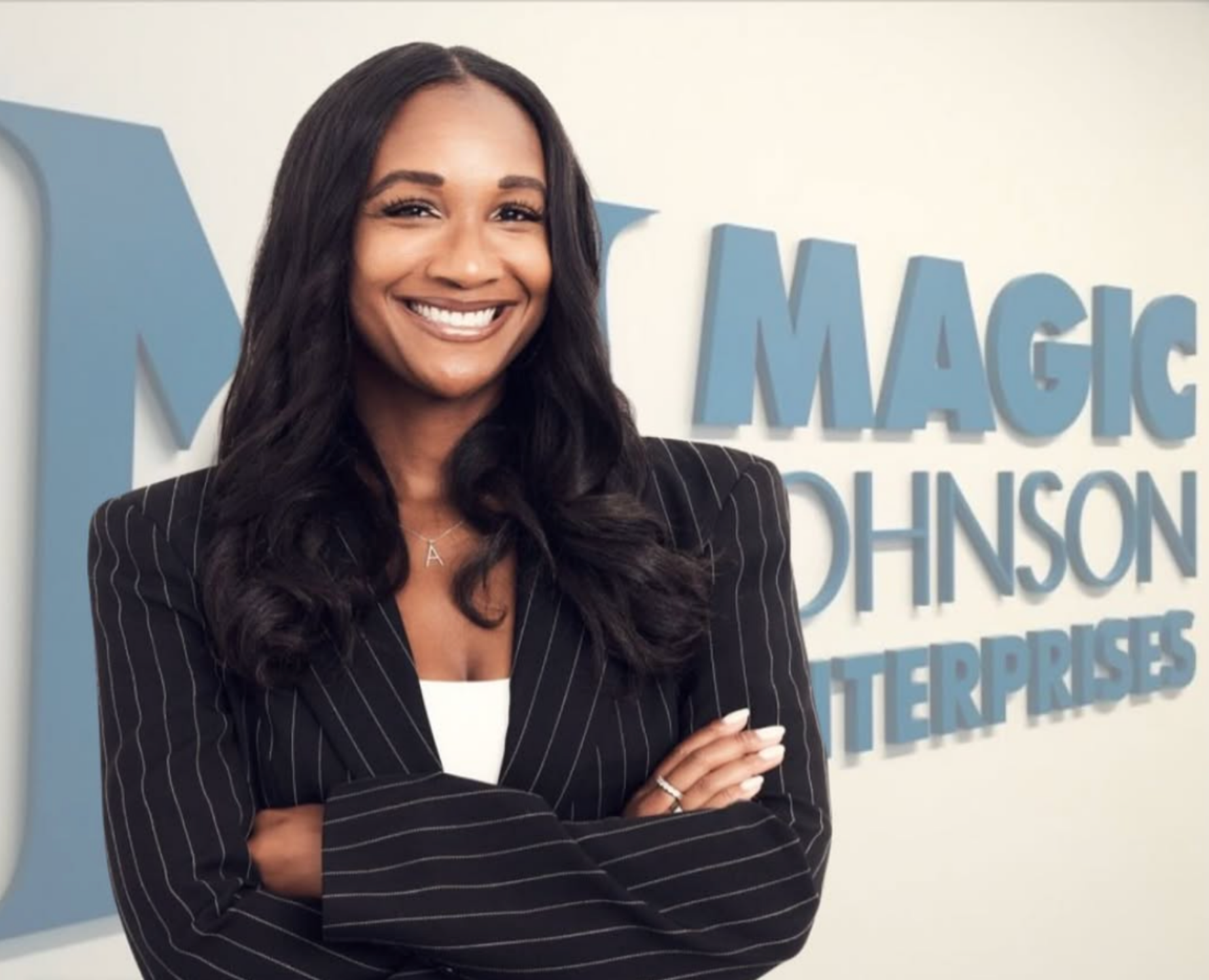
Magic Johnson Enterprises (MJE) has entered a transformational moment in its legacy of community-centered entrepreneurship: Alexia Grevious Henderson   has been named President of Magic Johnson Enterprises.

Her appointment is more than a new title—it signals a generational shift toward leaders who understand that wealth-building and community uplift are inseparable.

This is leadership rooted in excellence and guided by purpose.

A Leader Built for Impact


Henderson joined MJE in 2017 and has quietly become one of the strategic minds shaping partnerships, elevating brand influence, and expanding the economic reach of MJE’s mission. Rising from Senior Manager to Vice President—and now President—she has proven herself not just capable, but catalytic.

As Vice President of Strategic Partnerships and Marketing, she led:

  • major corporate collaborations
  • global brand partnerships
  • campaigns that expanded MJE’s economic influence

Under her leadership, MJE has strengthened its identity as a vehicle for community-driven growth and long-term economic empowerment. Magic Johnson summarized it best:


“Alexia is one of the brightest young minds in business today. Her leadership and creativity have elevated our brand, our partnerships, and our mission.”

A Career Anchored in Purpose


Before joining MJE, Henderson built foundational experience with the Washington Commanders and the NCAA. Her work has been nationally recognized, including being named:

  • Sports Business Journal’s “30 New Voices Under 30”
  • Diverse Representation’s “Top Ten to Watch”

Beyond her corporate success, she serves on the board of A.Bevy, helping young adults find direction, identity, and purpose—an example of leadership that extends beyond the office and into the lives of future innovators.

A Historic Representation Moment


Henderson’s presidency represents a breakthrough for:

  • women stepping into major corporate leadership
  • Black leaders shaping national investment strategy
  • the next generation building wealth, ownership, and opportunity


This moment proves something powerful: future-focused leadership doesn’t just inherit legacy—it expands it.

Rooted in Community, Positioned for Global Impact


Originally from Fort Mill, South Carolina, Henderson earned her degree from Clemson University and an MBA from Pepperdine University. Today she calls Los Angeles home—a city where entrepreneurship, culture, and economic innovation converge.

She now stands at the intersection of legacy and next-generation leadership—continuing a mission that impacts both boardrooms and neighborhoods.

About Magic Johnson Enterprises: 

Founded by Earvin “Magic” Johnson, MJE is a diversified investment company advancing opportunities across entertainment, sports, real estate, technology, and more—always with an eye toward access, ownership, and community prosperity. Its mission continues to demonstrate a powerful truth: When communities gain access, communities gain power.And when we elevate leaders who carry that purpose forward, we don’t just witness change - we build the future.


Never Miss a Story.
SUBSCRIBE

Contact Us

By Kim Anthony January 1, 2026
In communities across America, Black women are not just starting businesses — they are moving economies, shifting industries, and redefining what resilience looks like. According to Wells Fargo’s landmark study, The 2025 Impact of Women-Owned Businesses, Black/African American women entrepreneurs now operate nearly 2 million businesses, employing 647,000 people and generating $118.7 billion in revenue. These aren’t side hustles. They are engines — for families, neighborhoods, and the nation. And the report makes one truth undeniable. Closing the opportunity gap for Black women entrepreneurs isn’t charity. It’s economic strategy. Closing the Parity Gap Could Add Trillions Despite extraordinary gains, Black women still face higher barriers to capital, mentorship, networks, and procurement pipelines. Wells Fargo estimates that if Black/African American women entrepreneurs generated revenue on par with male-owned businesses, the nation could see up to $1.7 trillion added to the economy. The potential is not hypothetical — it is measurable. Policies that address wage inequities, expand access to capital, increase training opportunities, and open professional networks are essential. When these supports exist, the study shows, Black women entrepreneurs do far more than survive. They scale. They hire. They build wealth that ripples through generations. Capital is Expanding — and Awareness Must Catch Up Encouragingly, the financial landscape is widening. Wells Fargo highlights that more women are leveraging diverse financing pathways — particularly those designed with equity in mind. Among the most promising: Community Development Financial Institutions (CDFIs) Approval rates comparable to traditional lenders A 40% increase in certified organizations since 2018 Technical assistance + affordable capital bundled together The Wells Fargo “Open for Business” Initiative Flexible capital — grants, low-cost loans, forgiveness options — paired with capacity-building support helps women-owned businesses stabilize, grow, and create jobs, especially in underserved communities. SBA Lending Gains Women’s share of SBA loans has grown from 15.6% to 21.3% — a meaningful jump. Investment Crowdfunding A lifeline for founders outside major financial hubs, with 70% of capital coming from beyond the top 10 U.S. markets. State Small Business Credit Initiative (SSBCI) A $10 billion Treasury program unlocking private investment with a bold vision — including dedicated funding for equitable entrepreneurship through the Initiative for Inclusive Entrepreneurship. The opportunity — and the challenge — is awareness. Women must know which financial tools fit their stage and strategy, and ecosystems must ensure these resources remain accessible. Procurement: The Billion-Dollar Doorway When corporations and governments intentionally source from Black women-owned firms, the impact is exponential. Revenue grows. Jobs follow. Supply chains strengthen. Inclusive procurement isn’t just about fairness — it makes economies more competitive. Culture, Community, and Commerce Black women-owned businesses do something uniquely powerful: they build solutions from cultural insight. From beauty and wellness to technology, food, fashion, and media, these businesses grow from deep community understanding — and often expand into mainstream markets. They carry heritage. They create belonging. And increasingly, they shape national consumer trends. Building Ecosystems — Not Just Enterprises To truly unlock potential, the report calls for intentional infrastructure: Technology hubs and incubators Affordable marketplaces Co-working spaces designed for women founders Stronger public–private partnerships Investment in digital and physical infrastructure — including rural regions Fair, transparent lending practices Because entrepreneurship doesn’t flourish in isolation — it thrives in ecosystems. When Black women succeed in business, communities stabilize, families thrive, and the entire economy rises.
By Kim Anthony January 1, 2026
Senior U.S. Judge Thomas Thrash has ruled that the Fearless Fund, a venture capital firm based in Atlanta, can continue its grant program exclusively tailored for Black women entrepreneurs. The judge said the lawsuit challenging the practice, which argued it unlawfully excluded individuals of other races, was unlikely to succeed. The Fearless Fund, while a relatively small player in the global venture capital market, has come to symbolize the broader debate surrounding corporate diversity policies. However, the lawsuit against the organization may set a precedent as discussions on race considerations evolve within the workplace, particularly in light of the U.S. Supreme Court’s recent ruling in June ending affirmative action in college admissions. Sign up for our Daily eBlast to get coverage on Black communities from the media company who has been doing it right for over 133 years. Edward Blum, an anti-affirmative action activist well-known for his involvement in the Supreme Court’s June college admissions cases, is the head of the nonprofit American Alliance for Equal Rights, which requested the preliminary injunction. Blum has expressed plans to appeal the decision, claiming that civil rights laws prohibit racial distinctions based on overrepresentation or underrepresentation. The Fearless Strivers Grant Contest, which awards $20,000 to Black women entrepreneurs, remains at the center of the lawsuit. Blum argues that this contest violates a section of the Civil Rights Act of 1866, which prohibits racial discrimination in contracts. He claims that members outside the specified racial category are excluded. Judge Thrash contended that the grants constituted “charitable donations” aimed, in part, at acknowledging the discrimination faced by Black women business owners. He asserted that such donations are protected as “expressive conduct” under the First Amendment. The judge criticized the alliance’s attempt to alter the fund’s intended message. Gilbert Dickey, an attorney for the alliance, pointed out that the grant program does not extend to other racial minorities, including Hispanics. He argued that privileging one race over others violates First Amendment protection. The Fearless Fund maintains that its objective is to remove the obstacles that keep companies run by women of color from getting venture capital funding. “We will continue to run the nation’s first venture capital fund that is built by women of color for women of color,” declared Fearless Fund CEO and co-founder Arian Simone. “We realize there is still a long road ahead, but today we remain fearless and steadfast in creating pathways that empower women of color entrepreneurs.” Data from the nonprofit advocacy group Digital Undivided shows that less than 1 percent of venture capital funding goes to businesses owned by Black and Hispanic women. Founded in 2019, the Fearless Fund conducts the grant contest quarterly, with eligibility criteria stipulating that a business must be at least 51 percent owned by a Black woman, among other requirements. The NAACP Legal Defense Fund, the National Women’s Law Center, and the Gibson, Dunn, and Crutcher law firm have supported the Fearless Fund in fighting Blum’s lawsuit. Prominent figures, including civil rights advocate Ben Crump, have rallied to defend the Fearless Fund against allegations of discrimination. The Fearless Fund has invested over $26.5 million in businesses run by women of color with the support of industry titans like JPMorgan Chase and Mastercard. They have also awarded grants exceeding $3 million to Black women-owned businesses. Jason Schwartz, a partner at Gibson Dunn, stressed the importance of offering grants to Black women small business owners to achieve economic freedom. Alphonso David, another of the Fearless Fund’s lawyers, president, and CEO of the Global Black Economic Forum, condemned Blum’s claims as baseless attempts to subvert existing law. He affirmed their commitment to defend the Fearless Fund and its crucial work vigorously. “Today, the playing field is not level – that is beyond dispute,” David asserted in an earlier statement. “Those targeting Fearless Fund want to propagate a system that privileges some and shuts out most. They want to pretend that inequities do not exist. They want us to deny our history.” This article was originally published by NNPA Newswire. 
By Kim Anthony December 31, 2025
When Venus and Serena Williams stepped onto a tennis court decades ago, they didn’t simply play the game—they changed it forever. With every serve, every championship, and every barrier broken, they reminded the world that greatness refuses limitation and does not wait for permission. Now, they’ve made history once again—this time not in Wimbledon whites, but in ownership seats and billion-dollar boardrooms. Venus and Serena are the first Black women to own a stake in an NFL franchise, becoming investors in the Miami Dolphins—currently valued at more than $4.6 billion. This moment isn’t just a headline. It’s a statement. About possibility. About access. And about the evolving definition of leadership. From Courtside to Boardroom NFL ownership has historically been inaccessible to women—especially Black women. For two sisters who grew up in Compton, shaped by discipline, resilience, and unwavering belief, to sit at that table is monumental. This move signals more than participation—it signals transformation. They’re not just influencing sports on the field; they’re positioning themselves in the rooms where media, revenue, strategy, and power are negotiated. This is what it looks like when leadership moves from being the face of a sport to being architects of its future. Impact doesn’t retire. It reinvents itself. The Legacy They Continue to Build Venus and Serena have always been more than athletes. Their lives reflect a portfolio of brilliance—fashion, venture capital, wellness, philanthropy, and storytelling. Their investment in the Dolphins fits a pattern: they don’t simply enter industries; they elevate them. They didn’t just show the world what excellence looks like. They are showing the world what ownership looks like. And in their footsteps, a new generation is learning that greatness isn’t confined to a profession—it’s expressed through every arena you dare to enter. Lessons From the Williams Way Their journey offers timeless principles for emerging leaders, innovators, creators, and community-builders: Play with power and plan with purpose. Whether on the court or in corporate negotiations, every step reflects intention. Diversify your legacy. Mastery in one space is the beginning—not the destination. Representation is a form of leadership. When we see it, we believe it is possible. Ownership is influence. And influence shapes culture, economics, and opportunity. Not Just First—Foundational Venus and Serena aren’t simply breaking records; they’re building a new frontier—one where Black women take their rightful place as investors, leaders, and owners in one of America’s most powerful institutions: the National Football League. The Williams sister have always played to win. Now, they are playing to lead. And if history has taught us anything, it’s this: when the Williams sisters step forward, they don’t just open doors—they leave them open for everyone coming behind them.
Show More